

Nalanda Mahavihar: Did Bakhtiar Khilji Destroy it? – The Milli Gazette
When Modi was mouthing that Nalanda was burnt by foreign invaders, it fell in the same category of falsehoods which are used to spread hatred against Muslims.
The campus of Nalanda was inaugurated formally by Prime Minister Mr. Narendra Modi on 19th June 2024 in presence of Ambassadors of many countries like Myanmar, Sri Lanka, Vietnam, Japan, Korea among others. Most of these countries are ones where Buddhism was spread by preachers sent by Emperor Ashok. Initially, the idea of reviving Nalanda as a premier global university was floated by the then President A.P.J. Abul Kalam in 2006 and later ratified by the Bihar Assembly and the UPA Government. On the occasion, Prime Minister Modi stated that this university was burnt by foreign invaders in 12th century. He was only parroting the popular perception that Bakhtiyar Khilji, a courtier of Mahmud Ghori, had burnt it.
This perception is an add-on to the other such ‘social common sense’ that Muslim invaders destroyed Hindu temples and spread Islam by force. Incidentally, the propagation of these untruths began with the introduction of communal historiography by the British and later picked up with gusto by the communal streams, Muslim communalism and Hindu Communalism. While the propagation of myths propagated by Muslim League against Hindus is playing havoc in Pakistan, in India it is RSS which has played this up, leading to hate against Muslims in our society to the extent that Sardar Vallabh Bhai Patel had to write this about RSS, “All their speeches were full of communal poison. It was not necessary to spread poison in order to enthuse the Hindus and organize for their protection. As a final result of the poison, the country had to suffer the sacrifice of the invaluable life of Gandhiji.”
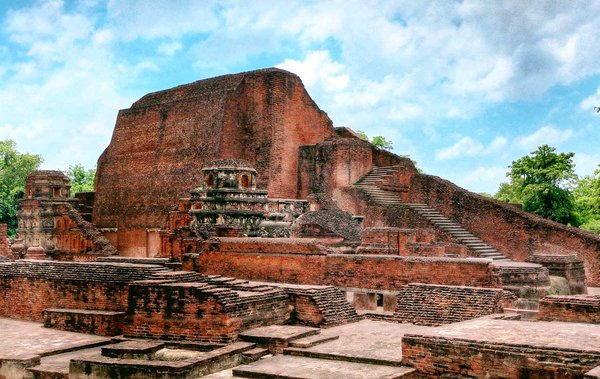
When Modi was mouthing that Nalanda was burnt by foreign invaders, it fell in the same category of falsehoods which are used to spread hatred against Muslims. Nalanda had a glorious residential university spread over a large area in Rajgir, Bihar, built by the Guptas in the sixth century. It was a Buddhist centre as archaeological evidence shows. Primarily, it was for the study of Buddhist philosophy. In addition, Brahminical scriptures, mathematics, logic and health science were also taught there. Its tradition of open discussion and logic were so high that it attracted students and scholars from various destinations. It was supported by the kings, later with the coming of Pala and Senaa dynasties its patronage was reduced and withdrawn. Patronage was redirected to new universities like Odantpuri and Vikramshila in particular.
This was the beginning of the decline of Nalanda. Who set fire to the great library housing millions of books, manuscripts and rare collections? While it is being attributed to Khilji, particularly after the coming of the British, there is no single primary source mentioning this. Khilji’s primary goal was to loot and plunder. On route from Ayodhya to Bengal he did attack Kila-i-Bihar thinking this is a forte with wealth. On the way, he plundered wealth and killed people. Nalanda was not on the route, rather it was far away from his route, and he had no particular reason to attack a university. Most of the primary sources related to the history of that time do not mention Khilji coming to Nalanda. Tabaqat-a-Nasiri, written by Minhaj-e-Siraj, has no mention on these lines. Two Tibetan scholars, Dharmaswamin and Sumpa, were keenly studying the history of India, particularly related to Buddhism, in their books. Khilji is not mentioned as the one who either came to Nalanda or burnt it. Taranath, another well-known Buddhist scholar from Tibet, also does not mention any such “fact”.
Interestingly, Buddhist structures of importance like Ajanta, Ellora, and Sanchi stupa were not the subject of ire of ‘invaders’! Nor do Indian historians like Jadunath Sarkar and R C Majumdar endorse Nalanda being destroyed by Khilji. So how it got burnt and lost its historical importance? Many stories abound apart from the Khilji destroying it, being most prevalent.
Prof. D. N. Jha, the authority on ancient Indian history, in his essay, ‘Responding to a communalist’ in the compilation of his essays (Against the Grain, Manohar 2020, pp. 185ff) gives an excellent summary of the relevant part of the book History of Buddhism in Indian by the Tibetan monk Taranath: “During the consecration ceremony of the temple built by Kakutsiddha at Nalendra [Nalanda], ‘the young naughty Shamans threw slops at tirthika beggars [i.e., Brahmins]…Angered by this, one of them went for arranging livelihood and the other sat in the deep pit and engaged himself in ‘Surya Sadhana…He performed a sacrifice and scattered the charmed ashes all around which resulted in the miraculous fire.”
History of Indian Logic (p. 516, cited by D R Patil, The Antiquarian Remnants in Bihar) says that this incidence refers to the actual scuffle between Buddhist and Brahmanical mendicants. The latter propitiated the Sun God, performed a sacrifice and threw the living ambers and ashes from the sacrificial pit on to Buddhist temples. This is what led to the burning of the great collection of books at that time.
We also need to register that this was a period when the attacks against Buddhism were coming up as the resurgence of Brahmanism was coming up in a big way. After the period of Ashoka when India became Buddhist in large measure, the notions of equality ruled in a big way. Due to this, the Brahamanical rituals declined leading to a big dissatisfaction among Brahimins. A bit later, when Ashoka’s grandson Brihdrath was ruling, his commander-in-chief Pushyamitra Shung murdered Brihdrath and became the ruler, unleashing anti-Buddhist persecution.
All reliable sources point to the fact of Brahmins burning the library as revenge. Bringing in Bakhtiar Khilji fits into the general Islamophobic propaganda against Muslims and at the same time hides the true story of persecution of Buddhism during that period.
What we need to preserve from the Buddhist period is a spirit of free debate and logic as the underlying base of education. In present times, our universities are being stifled by the imposition of a culture of obedience and subordination in the matters of academia. Knowledge cannot be imbibed or developed under such conditions. If we can learn this from the tragic history of the struggle between Buddhism and Brahmanism in India, it will be a crucial aspect of the development of academia in the country.
— Ram Puniyani’s latest book “Reading Savarkar” is now available on Amazon, Flipkart and Pharos Media.
कृपया इसे कम से कम 1 व्यक्ति को साझा करें Please Share this with atleast 1 Person:

Discover more from CNE Khabar
Subscribe to get the latest posts sent to your email.